

Para leer en español click aquí.
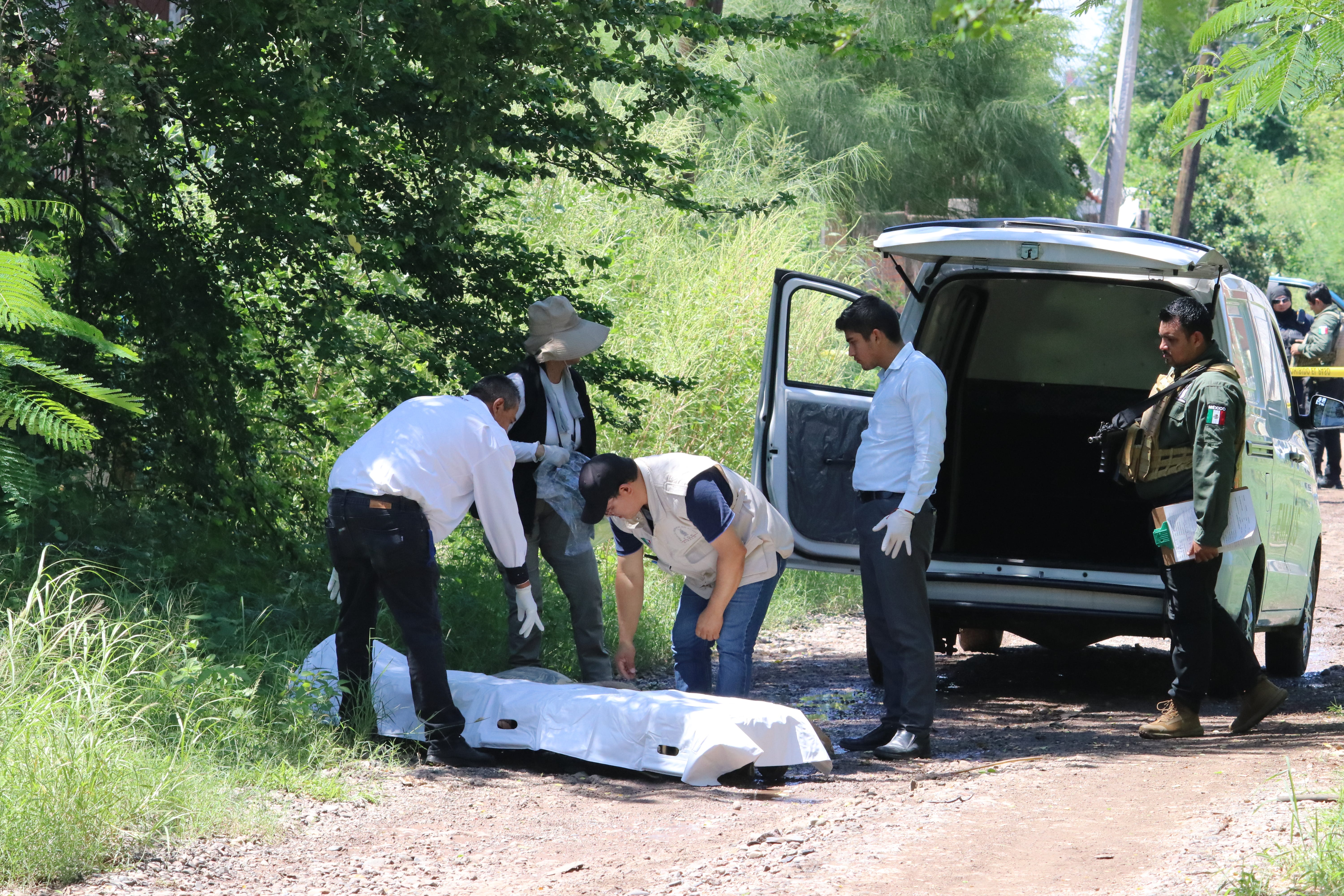
A forensic doctor working in the state of Guanajuato, Mexico, described to me how when he writes death certificates he looks at various factors. What type of wounds does the victim have? What weapon or object caused them? Were they self-inflicted or caused by an assailant?
However, he also has another element to consider. What do the crime bosses he has to answer to want on the piece of paper? For five years, he has liaised with a cartel that dominates his city, which gets him to send photos of corpses and crime-scene reports and can order him to file certain conclusions. They pay him, but he is under intimidation to work for them. Now he is in his sixties and wants to retire and they tell him not to.
“I’d like to get out of this and move away. But they know me and want to keep me in place,” says the doctor, who I meet up with in Mexico City where he is originally from.
The doctor’s testimony chimes with abundant evidence about cartel control in chunks of Mexico, such as cellphone records from a plaza boss, which I analyze here. Those messages confirm cartels have a range of officials on payroll and obtain police reports, including witness statements. The U.S. indictment of Sinaloa governor Rubén Rocha Moya alleges widespread criminal control of the police apparatus there.
Cartel infiltration of Mexico’s justice system makes it more difficult to find the truth about the level of violence and death. Yet there are other questions that are tough to answer. How often do cartels disappear victims so their bodies are never found? How frequently do cartel paramilitary squads haul away corpses of their fallen hit men? And centrally, how much is the government itself manipulating figures - or as they say in The Wire, “juking the stats”?
This is important to consider as President Claudia Sheinbaum announced what would seem to be resoundingly good news: that murders in Mexico have gone down 46 percent since she took office in October 2024. “The actions implemented as part of the National Strategy of Public Security are having an impact in all the country,” Sheinbaum, of the Morena party, said at her morning press conference on Tuesday.
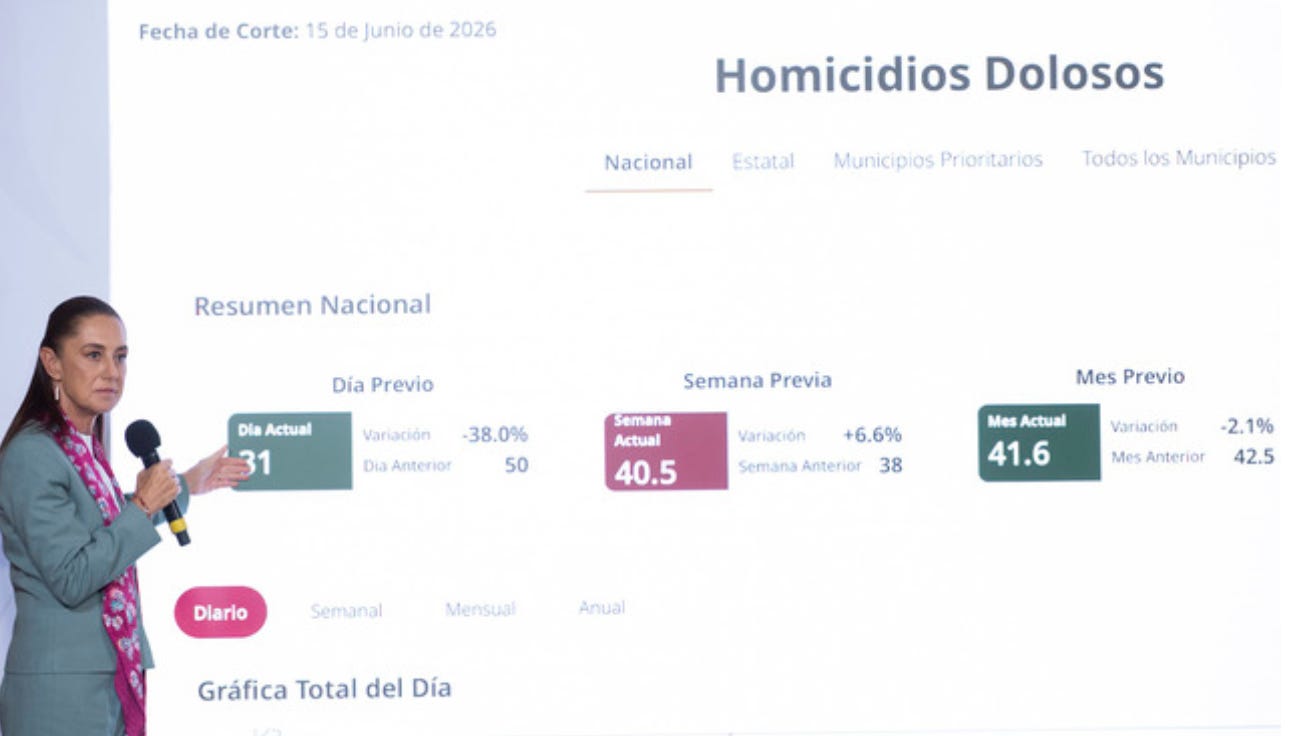
Some journalists and opposition politicians were quick to raise doubts about Sheinbaum’s claim. As Senator Mayuli Martínez, of the opposition PAN said: “Morena doesn’t fight violence, it covers it up,” using the Spanish verb “maquillar,” the equivalent of “juking.” Academics and reporters have written various pieces pointing out flaws in the government methodology of counting murders and underlined a major rise of disappearances.
However, diving deep into the data, I don’t think it’s all bad news. Evidence indicates there is a real reduction in the body count, although less than Sheinbaum says.
Manipulating murder numbers is not new; it certainly happened under President Enrique Peña Nieto and likely goes way back. It’s also not exclusive to Mexico. The Wire is set in Baltimore, Maryland, where show creator David Simon saw as a journalist how U.S. cops cook the books.
But while some murders can be hidden, not all can. Mexico has the asset of hardened reporters who race to murder scenes (la nota roja), making it tougher for police to cover up crimes. Bereaved families hold funerals for their loved ones.
Ernesto López Portillo, who heads the public security program at the Ibero university, tells me murder figures can be seen as an “approximation,” of the number of killings, and one of various factors to consider. While López Portillo raises questions about the official tally he thinks that overall there has been a reduction in murder.
“Everything indicates that homicides have gone down for multiple reasons,” López Portillo says. (But) “we can’t audit the system of information of the fiscalias [state prosecutor offices] so we haven’t got a possibility to validate and evaluate the statistical error there could be.”
Each murder is a human life gone, a family who lost a loved one, not just a number on an excel sheet. But we need to get into hard numbers and here I dig into the spaghetti of stats to make an assessment of where we are at. I look at holes in government figures; consider realistic estimates of a drop in murders; and examine how the Sheinbaum government (and Security Secretary Omar García Harfuch) are managing to reduce the pile of corpses.
Reclassifying Murders
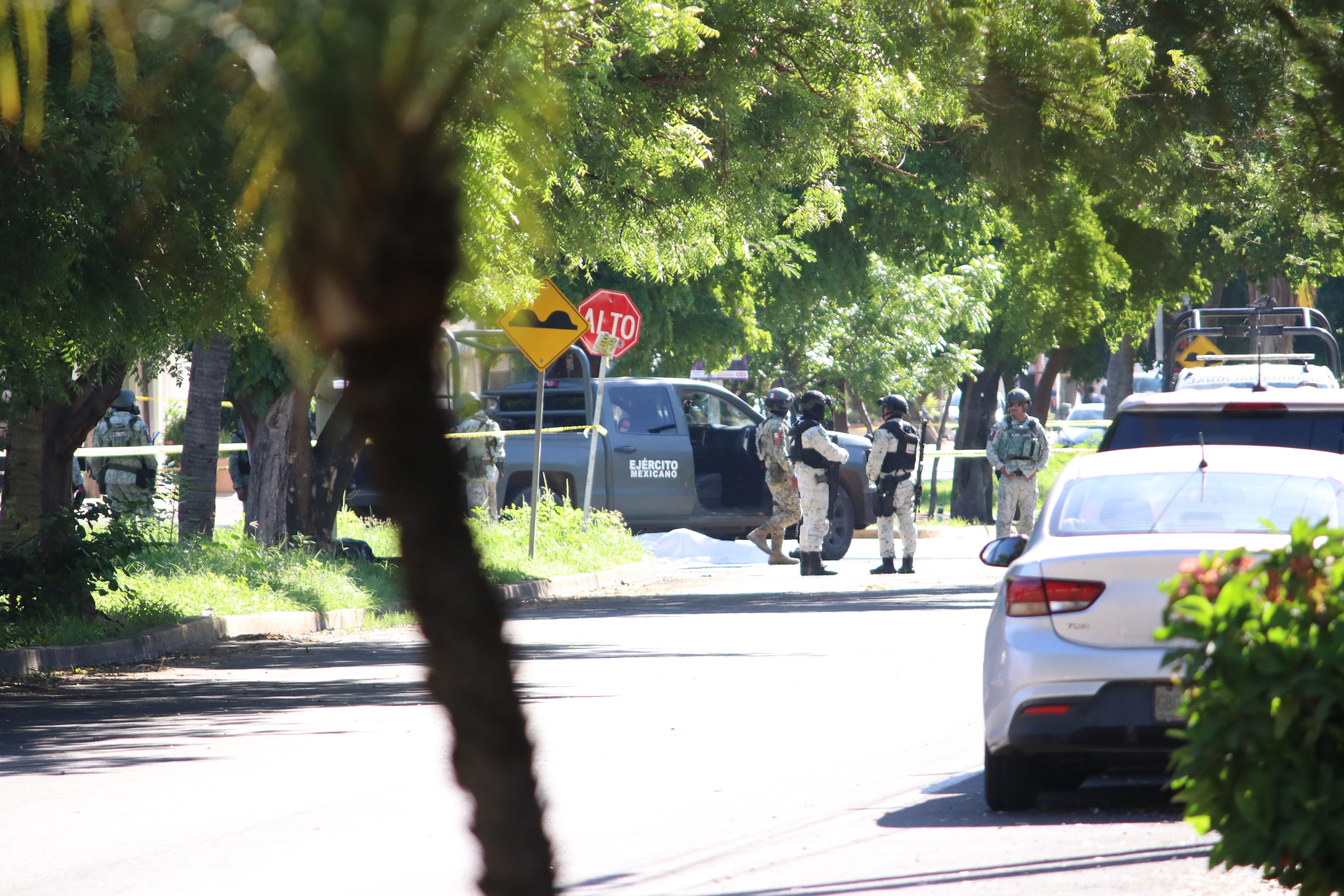
Adrián López directs the Noroeste newspaper in the embattled state of Sinaloa, where factions of the Sinaloa Cartel fight over the historic heartland of drug trafficking. His team of reporters rush to scenes of shootings (at risk to their safety) providing a record of the onslaught. Since a Sinaloa Cartel civil war erupted in September 2024, they have tallied over 3,400 murders as well as thousands of disappearances.
The government count is lower, however, and Adrián has found this is usually a question of classification. “They don’t record some victims as intentional homicides [homicidios dolosos], as they say they are collateral, or they are blown up by explosives, or they are killed by soldiers, or they are wounded and die in hospital several days later or various other reasons.”
When Adrián has tried to clarify this with officials, he hits a brick wall. “They tend to ignore us rather than threaten us,” he says.
The government releases national numbers based on these state police records with killings classified as intentional homicides and femicides, as well as manslaughter (homicidios culposos), which include some fatal accidents like traffic deaths. A red flag is when you find states with a high number of accidents caused by gunshots. There is another rather broad category of “victims of other crimes against life,” which have shot up sharply over the last decade, and could be a dumping ground for cases.
To add more confusion, there is a separate register of murders by the government statistics agency, or INEGI, based on medical reports. This is almost always higher than the police stats, although it’s also not bulletproof as the forensic doctor’s account shows. There are yet more tallies from media, think tanks and government task forces.
López Portillo made a public proposal to create an independent body to audit government murder numbers - which seems a great way to build long term transparency on the issue. However, the government has so far not accepted. Concerningly, López Portillo says, he finds that those working on the murder stats suffer intimidation.
“There are more people with evidence of problems in registers of homicides in state fiscalias but they don’t want to speak up. There is fear. There are threats. There are threats on journalists. There are threats on academics,” he said.
Disappearing Bodies
The second big way murders are covered up is through disappearances. Cartel squads, sometimes working with corrupt police, bury victims in mass graves, which have been unearthed across the country. The motives behind disappearing victims are mixed. On one side it strikes terror into the population; for this reason dictators like Baby Doc in Haiti used the tactic. But it also reduces the official body count, which means the government is less likely to send more soldiers into a specific city or state.
The number of disappearances first began rising after President Felipe Calderón launched a military crackdown on cartels in 2006. However, they rose again in 2015 (under Peña Nieto) and then more sharply still in 2022, under Sheinbaum’s mentor and Morena founder Andrés Manuel López Obrador. In both 2024 and 2025 there were more than 12,000 disappearances.
These cases include victims dragged away in front of their families by cartel gunmen. But the government has pointed out that gangsters are not behind all cases, and the missing can include run-away teenagers or fathers who abandon their families. This is a fair point, although it’s highly sensitive due to the traumatic nature of the violence on Mexican society and people have reacted angrily. Still, disappearances certainly count for many murders that are not included in official stats.
What is the real number then?
Sheinbaum’s claim of a drop of 46 percent is based on a comparison of months, contrasting September 2024 (an especially bloody month) with May 2026. A limitation with this is that monthly counts go up and down and it’s more telling to compare violence by year. While 2026 may well prove to be an important turning point, we are only half way through it.
Comparing 2024 to 2025, Sheinbaum’s first full year in office, there was a reduction in murders of 22.2 percent, according to the police count. However, security analyst Armando Vargas, of México Evalúa, published data in Nexos where he added up numbers for murder, manslaughter, disappearance and the “victims of other crimes against life” category. He found that total cases had dropped 8.6 percent between 2024 and 2025. Worse, he found the overall number of these crimes was still slightly higher than five years ago and much higher than ten years ago.
As noted above, not all missing are murders and many genuinely die in accidents. But a more realistic parameter for the fall of murders from 2024 to 2025 could be somewhere between these two points, or (considering that a sizeable chunk of the disappeared and others are homicides) perhaps 12 to 15 percent. This year could pan out to see a sharper drop.
This would still be an impressive reduction considering Mexico has suffered rising violence for two decades. How did the government do it?
Lock Em’ Up
While Sheinbaum gets praise round the world as a leftist leader, her security forces have been incarcerating more people. López Portillo finds that Mexico’s total prison population increased by 21,000 inmates, or 8.6 percent, between April 2025 and April 2026.
This is far less than under Nayib Bukele in El Salvador, who incarcerated an additional 1 percent of the entire population in a year. Yet it’s significant.
Considering the security crisis in Mexico, I think jailing more thugs is justified. However, López Portillo points out that Mexico has a high rate of inmates who are never sentenced but simply kept in prison under charges and then ultimately released. A number of new prisoners therefore could be innocent. Even if true though, many of those locked up surely are cartel gunslingers so increased incarceration is still probably reducing the murder count.
A second point is that García Harfuch says he is using intel to target the most violent players. These include cartel paramilitary commanders like El Perris of the Chapitos (shot down by soldiers) and El Jardinero of the Jalisco New Generation Cartel (arrested). This is likely having an effect.
Finally, some of the cartels themselves could be reigning in violence. Sinaloa is an exception with the civil war raging, and Adrián at Noroeste says there are even signs of infighting inside the different factions. But recent messaging from the Jalisco Cartel, reportedly under the new leadership of El-3, suggests it wants to show itself as controlling crime and murder within its territory, perhaps in an effort to reduce heat from the federal government. Other groups such as the Gulf and Northeast cartels could be doing the same.
The murder rate is still high despite the reduction, and with Mexico suffering half a million homicides in the last two decades it will take time for people to feel the effects of any drop. Murder is also only one part of a crime wave and offenses such as extortion are still rampant. But I don’t want to be totally negative. Change has to begin somewhere. Sheinbaum and García Harfuch at least have a strategy and are getting results, even if I would love to see more transparency about exactly what those results are.
All photos by Fidel Durán except photo 2, from Presidencia de la Republica
Copyright Ioan Grillo and CrashOut Media 2026

Great topic to shed light on! I've been wondering about this exact topic, so I loved reading the different arguments for what might be going on
There's a site that tracks both INEGI and SESNSP homicides state-by-state: https://elcri.men/en/ Lots of suspicious gaps
This one tracks incarceration over time https://www.prisonstudies.org/country/mexico
The 10-15% rise since 2018 is real, but that they are still below the 2015 peak. As I understand it Mexico made some judicial reforms that made it harder to keep people in prison without trial, so perhaps they are doing a slightly better job of locking up the right people?
I also have a web page that tracks the FBI / CDC gap in the USA. The gap between them is very similar to the one in Mexico, but I suspect the drivers are different: https://theusaindata.pythonanywhere.com/underreported_homicides
Thanks again for the article, I love seeing a new CrashOut in my email.
World Cup update-
I was amazed by Tuchel's strategy change encouraging the English players to be aggressive and less fearful. Even his substitutions were agressive. Where was this strategy when he coached Borussia Dortmund and Bayern Munich. Even at Chelsea, his strategy seemed mechanized and too controlled even with his success at Chelsea. I think the ghost of Jurgen Klopp has permeated his football mind.
Typical Steven Clarke strategy against Morocco. Completely negative and does not even put Shankland, Scotland's most prolific striker in the match. Absolutely pissed.
South Korea was even more negative against Mexico and their performance was a disgrace.
US battle against the Australian thugs was impressive although the US needs to be more ruthless at goal.